The Echo Chamber: Why the Late May Shift to Cancer Energy is Weaponizing Relationship Nostalgia
This article may contain affiliate links. If you make a purchase through one of these links, we may earn a small commission at no extra cost to you.
The Emotional Architecture of the Cancerian Ingress
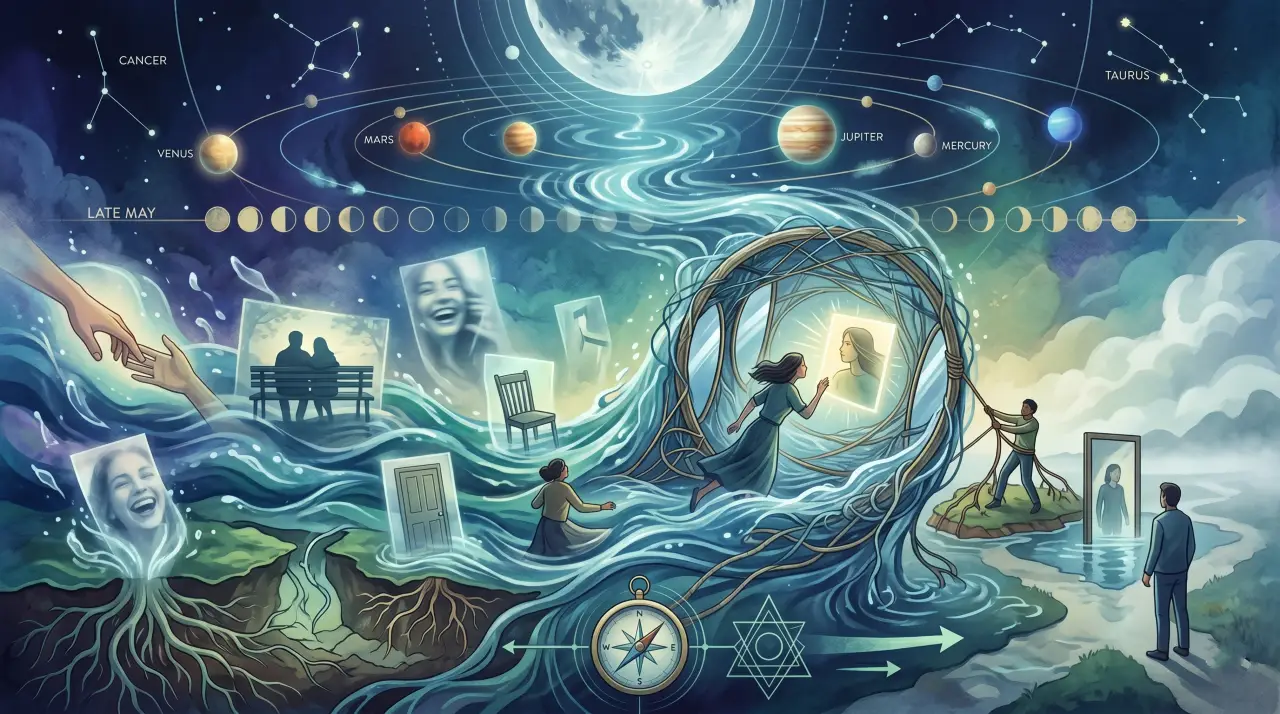
The transition of planetary energy in late May 2026 marks a profound disruption in the emotional architecture of contemporary relationships. Prior to this shift, the cosmic landscape was dominated by highly intellectualized, communicative, and detached dynamics, driven by Mars in Aries, Venus in Gemini, and a pragmatic Sun-Mercury conjunction in Taurus. These transits favored cognitive processing, strategic compartmentalization, and rapid, low-stakes interactions. However, the landscape shifts dramatically as Venus ingresses into the cardinal water sign of Cancer, initiating a massive reallocation of psychological energy from the conscious, analytical mind back into the deep water of the subconscious.
The Lunar Blueprint maintains that this planetary ingress acts as a systemic trigger within the human psyche. When the planet of relational connection enters the lunar-ruled domain of Cancer, the defense mechanisms of intellectual detachment begin to dissolve. The individual’s focus shifts from the pursuit of novel intellectual stimulation to an intense, safety-seeking drive for emotional security, protective intimacy, and familiar relational structures.
This transition carries a significant psychological hazard: it systematically weaponizes relationship nostalgia. Rather than facilitating clear, objective evaluations of current compatibility patterns, the watery influence of Cancer floods the subconscious with idealized memories. The brain ceases to evaluate partners based on real-time behavior, defaulting instead to a highly curated, sentimentalized version of the past.
Astrological Mechanics and the Subconscious Mapping of 2026
The structural timeline of late May and June 2026 reveals a compounding emotional sequence that systematically deepens the human retrospective drive. This sequence begins with the Venusian entry into Cancer, but quickly accelerates as multiple planetary bodies collect within this sensitive water sign, creating an intense “echo chamber” of past emotional attachments.
| Date (2026) | Planetary Movement | Subconscious & Relational Mechanism |
| May 1 | Full Moon in Scorpio | Illuminates root causes, intensifies emotional depth, and forces a confrontation with hidden relationship dynamics. |
| May 18 | Venus enters Cancer | Initiates a collective craving for emotional safety, vulnerability, and domestic comfort over superficial connections. |
| May 18 | Mars enters Taurus | Slows down active physical momentum to a crawl, channeling energy into long-term preservation and stubborn attachment to the familiar. |
| May 31 | Full Moon in Sagittarius | Acts as a cosmic wildcard, highlighting the tension between the urge to escape and the security of past bonds. |
| June 2 | Jupiter enters Cancer | Amplifies the demand for emotional healing, expanding subconscious patterns, family dynamics, and karmic bonds. |
| June 9 | Venus-Jupiter Conjunction | Represents the peak of romantic magnetism, heavily increasing the risk of over-idealizing past partners. |
| June 22 | Mercury enters Cancer | Merges cognitive reasoning with subjective feeling; communication becomes deeply intuitive and memory-driven. |
| June 29 | Mercury Retrograde in Cancer | Forces a mandatory psychological review, dragging unresolved attachment histories back to the surface. |
This mechanical sequence demonstrates how the initial sentimentality of late May is not a fleeting mood, but rather the foundation for a prolonged retrospective cycle. By the time Mercury stations retrograde in Cancer on June 29, the mind is fully primed to seek resolution by returning to past relationship dynamics. This period forces individuals to confront their natal Moon Signs, as the moon’s rulership over Cancer means that any transiting activation of this sign directly triggers one’s primary instinctual needs for safety and belonging.
The Cognitive Biases Triggering Romantic Recurrence
To understand why the human mind is so easily deceived by the memory of a past relationship during these water transits, one must look to the cognitive frameworks that govern memory consolidation. The brain does not operate as an objective video recorder; instead, it relies on reconstructive processes that are highly susceptible to current emotional desires.
The primary psychological mechanism activated during this Cancerian shift is the Fading Affect Bias (FAB). This bias dictates that the emotional intensity of negative memories fades much faster than the emotional intensity of positive memories. Under the influence of Venus in Cancer, this bias is heavily stimulated.
While the pain, conflict, and fundamental incompatibilities that caused a breakup lose their emotional charge, the memories of warmth, safety, and initial infatuation remain highly vivid. Consequently, the relationship is recalled through a highly distorted, romanticized lens, leaving the individual vulnerable to believing that a second chance is a logically sound decision.
This process is further complicated by Rosy Retrospection, a cognitive bias that causes individuals to recall the past more fondly than the present, systematically filtering out historical stressors while hyper-focusing on immediate, real-time anxieties.
In evolutionary biology, this selective memory served to reduce cognitive load and encourage repeat engagement in highly demanding adaptive behaviors, such as social bonding and caregiving. However, when activated by the current planetary alignment—as outlined in the Moon Omens astrology forecast—this evolutionary mechanism backfires, leading individuals to mistake a survival-based craving for familiarity for genuine relationship compatibility.
Understanding your synastry is just the surface. To see the full map of your emotional blueprint, check out this personalized video analysis.
Attachment Theory and the Zeigarnik Loop in Relationship Compatibility
The subconscious compulsion to revisit past connections during this water-heavy season is heavily tied to the Zeigarnik Effect. This psychological principle demonstrates that the human brain retains a hyper-vivid memory of unfinished, interrupted, or unresolved tasks compared to those that have reached a definitive conclusion.
When a relationship ends abruptly, without clear closure, or under a cloud of unspoken words, the subconscious registers the connection as an “open file”. As Venus and Jupiter transit through Cancer, the mind actively seeks to close this cognitive loop, replaying old scenarios and constructing elaborate, fantasy-based scripts of reconciliation.
This psychological loop interacts directly with adult attachment styles, altering how individuals experience their Synastry Aspects and transiting triggers:
- Anxious and Secure Attachment Styles (Low-Avoidant): For individuals low in attachment-related avoidance, nostalgia acts as an active social driver, heightening their desire for intimacy and prompting them to actively pursue past partners to re-establish a sense of interpersonal safety.
- Dismissive and Fearful Attachment Styles (High-Avoidant): Conversely, for individuals high in attachment-related avoidance, nostalgia is frequently utilized as a defensive deactivation strategy. By hyper-focusing on “the one who got away”—an idealized, unreachable partner safely situated in the past—they can satisfy their craving for closeness without having to engage in the vulnerable, unpredictable, and messy work of a real-time relationship in the present.
Subconscious Mapping and Retrograde Remediation Strategies
To navigate the watery depths of the late May Cancerian shift without falling victim to the illusions of weaponized nostalgia, the research team at The Lunar Blueprint recommends implementing highly objective, data-driven remediation strategies :
- Audit Contemporaneous Records: Because memory is highly reconstructive, individuals must not rely on current emotional recall. One should actively consult objective records from the period of the breakup—such as journals, messages, or emails—to ground the conscious mind in the reality of why the partnership originally dissolved.
- Isolate the Function from the Person: It is critical to dissect whether the mind is longing for the actual human being, or if it is longing for the specific emotional state—such as safety, validation, or youth—associated with that era of life.
- Track the Physical Senses: With Mars in Taurus slowing down physical progress, emotional stress will manifest as physical tension in the neck, jaw, and shoulders. Utilizing grounding physical routines will assist in separating genuine emotional intuition from survival-based somatic panic.
- Establish Clear Boundary Protocols: Rather than succumbing to the urge to send a late-night text when the moon transits sensitive water signs, individuals should implement a strict delay protocol, allowing the immediate emotional wave to pass before acting on impulsive nostalgia.
By applying these objective cognitive overrides, the mind can successfully transmute the highly sensitive Cancerian transits, moving away from regressive relationship loops and toward a state of genuine, self-sourced emotional sovereignty.
Unveil Your Cosmic Architecture
Your natal chart holds the exact coordinates to your relationship patterns. Understand the deeper currents pulling you together.
Claim Your Free Moon Reading